
Designing with Composites
Designing with composites is not about selecting a material — it is about engineering material behaviour through fibre‑led design. This approach builds on the fundamental interaction between fibres and resin that defines composite materials. If you are new to fibre reinforced composites, start with What are Composites.
Unlike metals, where properties are largely fixed and isotropic, fibre‑reinforced composites allow engineers to define performance through fibre orientation, material architecture and manufacturing process. This creates a fundamentally different design logic for composite structures, where structure, material and manufacturing process are inseparable.
In practice, this means that early composite material design decisions carry disproportionate weight. Fibre direction, cross‑sectional logic and process selection determine not only structural performance, but also manufacturability, cost efficiency and long‑term reliability. When these elements are aligned from the outset, composites enable highly efficient structures that combine low weight with stiffness, durability and predictable behaviour in use.
Designing with composites means defining structural performance through fibre placement and process‑aware geometry, rather than relying on uniform material properties. At Exel Composites, this approach is industrialised through advanced composite manufacturing methods that enable consistent quality and scalable production. Depending on the application, these may include processes such as
pultrusion and pull-winding.
These approaches allow fibre‑led design principles to be translated into repeatable, high‑quality production at scale, connecting engineering intent directly to industrial reality.
Composite design principles
Composite design principles are defined by how fibre‑reinforced composites behave under load. Unlike isotropic materials, performance is governed by fibre direction, structural response and how loads are distributed through the material.
Principles you design to (not against)
The defining principle of composite design is anisotropy. In fibre‑reinforced composites, mechanical properties are directional and follow the fibres, meaning that performance is placed where it is needed rather than distributed uniformly across the structure.
This is not a limitation — it is the primary advantage. When fibres are aligned with load paths, material efficiency increases significantly, allowing structures to achieve high stiffness and strength with minimal weight. When this principle is ignored and composites are treated like isotropic materials such as metals, designs tend to become heavier, more complex and less predictable in performance.
At the same time, composites change how structures are governed. While strength is often high relative to weight, stiffness and deflection typically become the controlling factors in design. This shifts how engineers approach sizing, validation and performance prediction.
In practical terms:
- Fibre alignment defines how loads are carried
- Off‑axis behaviour is governed by fibre architecture and matrix interaction
- Deflection, vibration and stability often govern before strength
Designing with composites is therefore about understanding how structures deform under load, not just how they fail.

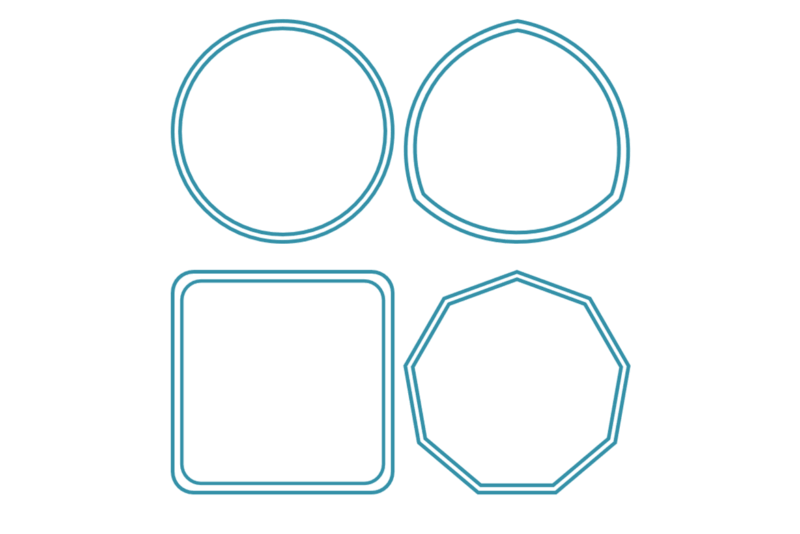
Composite geometry and detailing for manufacturing
Effective composite design depends on how geometry supports both structural performance and manufacturability. In fibre‑reinforced composites, shape is not independent from material behaviour — it directly influences how fibres can be placed, how loads are carried and how consistently a part can be produced.
Rather than thinking in terms of geometric freedom, it is more useful to think in terms of geometric efficiency. Shapes that support fibre continuity and stable production conditions tend to deliver better structural performance and lower overall complexity.
Well‑performing designs typically share a few characteristics:
- Cross‑sections remain consistent along the length
- Transitions in thickness are gradual rather than abrupt
- Radii are sufficient to maintain fibre alignment
- Internal complexity is introduced only when structurally justified
Composite lay‑up design and material structuring
Effective composite design at concept stage is not about selecting materials in isolation, but about structuring how fibres and matrix systems work together to carry loads. The objective is to define how performance is built into the material system from the outset, rather than optimising it after geometry has been fixed or considerations of manufacturing methods have been introduced later.
Structuring performance through lay‑ups
A well-designed lay‑up reflects the actual load conditions the structure will experience. Instead of accumulating material, performance is achieved through intentional fibre placement and orientation.
In practical terms:
- Unidirectional fibres carry primary axial loads
- Off‑axis layers support shear and torsion
- Multiaxial configurations stabilise the structure under complex loading
- Mats and veils contribute to surface durability and protection
The efficiency of a composite structure comes from placing material only where it contributes to load carrying or protection. Adding extra layers without a clear structural role does not inherently improve performance and often leads to unnecessary weight and complexity.
Material selection follows operating conditions
Resin systems and non-structural materials are selected based on the environment in which the composite will operate, rather than purely on mechanical performance. Temperature, chemical exposure, UV stability and fire behaviour typically define the appropriate material system early in the design process.
This reinforces a key principle: structural behaviour is primarily defined by fibre architecture, while long-term performance depends on how well the material system matches real operating conditions, supported by relevant technical specifications and performance data.
Process-aware design decisions
Process-aware design decisions shape whether a composite concept can be translated into repeatable, high-quality manufacturing without unnecessary redesign. In composite engineering, manufacturing is not a downstream activity added after the design is complete — it is one of the factors that determines what a structure can realistically achieve in terms of performance, consistency and scalability, depending on the chosen manufacturing methods.
This changes how decisions are made at concept stage. Geometry, fibre architecture and material selection cannot be defined independently and then handed over for production. They need to be developed with an understanding of how the part will be formed, how fibres behave during manufacturing, and how much variation can be controlled in serial production.
When design is developed with manufacturing in mind from the outset, structures tend to become simpler, more robust and easier to industrialise. This often means favouring solutions that support stable fibre placement, consistent cross-sections, controlled transitions and repeatable quality outcomes — principles that are reflected in many engineered composite solutions developed for demanding applications.
In practical terms, process-aware design usually involves a few key decisions:
- selecting geometries that can be produced consistently
- aligning fibre architecture with what can be controlled in manufacturing
- reducing unnecessary features, interfaces and secondary operations
- designing for repeatability, not only for theoretical peak performance
The value of this approach is not only technical, but practical. When manufacturing considerations are integrated early, development becomes more efficient, validation is more predictable, and scale-up is less likely to introduce avoidable compromises. This leads to more consistent outcomes, supported by reliable technical specifications and performance data.
Process-aware design is therefore not about limiting engineering freedom. It is about making better design choices earlier — so that composite performance can be delivered consistently, economically and at industrial scale.

Materials for composite design
Materials in composite design are selected to support both structural performance and long-term behaviour in service. While fibre architecture defines how loads are carried, the surrounding material system determines how the structure performs under environmental, chemical and operational conditions.
Resin systems: defining environmental performance
Resin systems determine how a composite behaves in its operating environment. Selection is rarely based on a single property, but on balancing durability, temperature resistance, chemical exposure and regulatory requirements.
Typical resin systems follow a functional hierarchy:
- Polyester systems provide cost-efficient performance in general environments
- Vinyl esters improve resistance to chemicals and moisture
- Epoxies enable higher mechanical and thermal performance
- Acrylic systems are used where fire, smoke and toxicity requirements are critical
Resin selection is therefore primarily driven by operating conditions rather than structural loads. The goal is to match the material system to the environment the structure will experience over its lifecycle. For a more detailed overview of how resin systems differ and are applied, see resin choices in composite design.
Reinforcements: Defining structural behaviour
Reinforcements define how loads move through a composite structure. Performance is achieved through intentional fibre placement, not by increasing material volume.
Key reinforcement roles include:
- Axial fibres providing stiffness and strength along load paths
- Angled fibres supporting shear transfer and torsional loads
- Multiaxial configurations creating balanced and stable behaviour
- Mats and veils contributing to surface durability and protection
This reinforces a consistent principle across composite design: material should only be used where it contributes directly to load carrying or structural integrity. More detail on fibre types and architectures can be found in the reinforcements guide.
Surface layers and aesthetics: functional performance, not just appearance
In composite structures, surface design is rarely purely aesthetic. Surface layers often contribute directly to durability, lifecycle performance and maintenance requirements.
Examples include:
- Pigmented resins for visual appearance
- Surface veils enhancing corrosion protection and UV resistance
- Glass tissues for paintable surfaces
- Coatings extending performance in aggressive environments
Integrating these functions into the material system can reduce or eliminate the need for secondary processing steps, improving both efficiency and long-term reliability.
Material selection in context
Material selection in composite design is not a standalone decision. It is part of a broader system where:
- Fibre architecture defines structural performance
- Resin systems define environmental resistance
- Surface layers support durability and finishing requirements
These choices must align with geometry and manufacturability to deliver consistent performance in production. Supporting technical specifications can be used to validate material behaviour and ensure that the selected system meets real-world requirements.

Quick selection logic for early composite design
Early-stage composite design benefits from a structured way of narrowing down material and design decisions without over‑optimising too soon. Rather than starting with detailed specifications, it is more effective to define a small set of governing conditions that shape the direction of the design.
A simple progression helps keep decisions grounded in real operating requirements while maintaining flexibility during concept development:
- Environment
Identify the operating environment first. Chemical exposure, moisture, UV radiation and outdoor conditions will strongly influence material selection, particularly resin systems.
→ See resin choices in composite design for how different systems perform in varying conditions. - Temperature range
Define expected operating and peak temperatures early. Thermal performance often limits material selection and influences long-term durability. - Load directions and behaviour
Consider how loads are applied and distributed. This determines fibre orientation and lay‑up structure, rather than selecting materials based only on generic strength values.
→ Further guidance on fibre behaviour is available in the reinforcements guide. - Regulatory and safety requirements
Fire performance, smoke generation and compliance requirements may significantly constrain material choices, particularly in transport and infrastructure applications. - Cost and scalability constraints
Evaluate cost in relation to manufacturability and production scale. Efficient composite design is achieved by aligning performance requirements with solutions that can be produced consistently using suitable manufacturing methods.
Following this progression helps prevent common issues in composite development, such as over-specifying materials too early, misaligning fibre architecture with real load conditions, or selecting solutions that are difficult to manufacture at scale.
At this stage, the goal is not to identify the final configuration, but to establish a technically viable direction that can be validated and refined using technical specifications and detailed design development.
Lifecycle view: design, production, installation and maintenance
Composite performance is not defined at a single stage of development — it emerges across the entire lifecycle of the product. Decisions made during design influence manufacturing stability, installation efficiency and long-term durability in ways that are often more tightly coupled than in traditional materials.
At concept stage, the focus is on defining load paths, material structuring and manufacturability. During production, consistency in fibre placement, geometry and material behaviour becomes critical to achieving predictable outcomes at scale. Installation introduces practical considerations such as handling, interfaces and assembly tolerances, while long-term performance depends on how well the material system resists environmental exposure and maintains structural integrity over time.
This interconnected lifecycle changes how composite structures are developed. Instead of optimising each phase independently, higher-performing solutions are achieved when the full lifecycle is considered early and holistically.
In practice, this means:
- Design defines load paths, fibre architecture and manufacturability
- Production ensures consistency, repeatability and quality control
- Installation governs handling, joining and real-world tolerances
- Maintenance determines durability, inspection intervals and lifecycle cost
When these stages are aligned, composite structures deliver consistent performance and reduced lifecycle complexity. When they are treated in isolation, inefficiencies tend to appear — typically in the form of redesign, installation challenges or reduced durability.
At Exel Composites, lifecycle thinking is embedded into engineering and production capabilities, enabling the translation of design intent into scalable, repeatable solutions. This connection between concept and industrialisation ensures that performance is not only achieved in theory, but maintained in real-world applications such as composite solutions across demanding environments.

Final takeaway
Designing with composites requires a shift in thinking — from selecting materials to engineering behaviour. Performance is not defined by a single parameter, but by how structure, materials and manufacturing interact across the lifecycle.
When fibre architecture, geometry and manufacturing are aligned early, composites enable efficient, durable and scalable solutions that outperform traditional materials in demanding applications. When they are not, complexity increases and performance becomes less predictable.
Understanding these principles allows engineers and designers to use composites as a true design tool — not just an alternative material — and to translate concept-level decisions into reliable, real-world outcomes.
If you want to revisit the material fundamentals behind these design decisions, see What are Composites.
FAQs
Q1: When should composites be considered in a project?
Composites should be considered at the concept stage, when geometry, material structure and manufacturing approach can still be developed together. Early involvement allows design decisions to align with performance, manufacturability and lifecycle requirements.
Q2: What is the most common mistake in composite design?
The most common mistake is treating composites as isotropic materials and applying metal design logic. Failing to align fibres with load paths typically leads to inefficient structures, higher weight and less predictable behaviour.
Q3: Do composites always reduce weight?
They often do, but weight reduction is not the only advantage. The primary benefit of composite design is improved structural efficiency — combining stiffness, durability and performance across the full lifecycle.
Q4: Are manufacturing processes limiting design freedom?
No. Manufacturing processes favour efficient and well-structured designs rather than unnecessary complexity. When design is aligned with manufacturing methods, both performance and scalability improve.
Q5: How are materials selected in composite design?
Material selection is driven by both structural and environmental requirements. Fibre architecture defines how loads are carried, while resin systems determine performance in operating conditions. See resin choices in composite design for more detail.
Q6: How can composite performance be validated?
Performance is validated through engineering analysis, testing and reference to reliable technical specifications. These provide data on material behaviour and ensure that designs meet real-world requirements.
Q7: What types of structures benefit most from composites?
Composites are particularly effective in applications where weight, durability and resistance to environmental conditions are critical. Typical examples include structural profiles, tubes and custom-engineered solutions where fibre alignment can be optimised for performance.