
Manufacturing with composites
Composite manufacturing is more than the step where raw materials become finished products. In fiber-reinforced composites, manufacturing decisions influence geometry, mechanical performance, scalability,and the final characteristics and cost of the product. Unlike many traditional materials, where properties are largely defined before production begins, composite products can be tailored through manufacturing processes, reinforcement strategies, and material combinations.
Here at Exel Composites, continuous manufacturing technologies are used to produce composite profiles and tubes with consistent quality and repeatable performance at industrial scale. By combining material expertise with advanced manufacturing processes, composite solutions can be optimised for specific application requirements while maintaining production efficiency and reliability.
Compared with smaller batch composite manufacturing methods, such as RTM, prepreg lay-up, or wet lay-up, continuous manufacturing is designed for repeatable production of long, uniform profiles and tubes. Instead of producing one part or mold cycle at a time, reinforcements and resin are processed in a controlled, continuous line, which supports consistent fiber alignment, resin distribution, dimensional stability, and mechanical performance along the full length of the product.
Batch methods can be a good fit for prototypes, short runs, or complex 3D geometries, but when the product has a constant cross-section and volumes grow, continuous manufacturing can offer faster output, less variation, reduced waste, and better cost efficiency at industrial scale.
As a result, the cost per metre of product falls significantly as production volume increases.
Continuous manufacturing technologies at Exel
At Exel Composites, composite profiles and tubes are manufactured using continuous production technologies designed to deliver repeatable quality, efficient production, and consistent mechanical performance. Continuous manufacturing enables reinforcement materials and resin systems to be combined in a controlled process, helping to ensure predictable product quality even for large production volumes.
While both pultrusion and pull-winding transform fibres and resin into high-performance composite products, they are designed to address different application requirements. The choice of manufacturing technology depends largely on product geometry, performance objectives, and reinforcement requirements.
Pultrusion vs pull-winding
| Pultrusion | Pull-winding | |
| Typical geometry | Profiles, rods, bars, and other constant cross-section components | Tubes and tubular components |
| Reinforcement strategy | Primarily axial reinforcement | Axial and circumferential reinforcement |
| Performance focus | Consistent mechanical performance and efficient production | Tailored tubular performance and enhanced hoop strength |
| Design flexibility | Optimised for profile geometries | Additional flexibility for tubular applications |
| Typical use | Structural profiles and components | Lightweight and high-performance composite tubes |
| Learn more | Pultrusion | Pull-winding |
Choosing the right manufacturing approach
Pultrusion is typically selected for structural profiles where consistent geometry, mechanical performance, and efficient production are important. Pull-winding extends these capabilities for tubular products by introducing additional reinforcement orientations that can improve hoop strength, torsional performance, and application-specific mechanical behaviour.
Together, these technologies enable manufacturers to match manufacturing capability with product requirements, helping engineers develop composite solutions that balance performance, durability, and production efficiency.
The adjacent video displays how pultrusion, pull-winding and continuous lamination work.

Quality and repeatability at scale
One of the key advantages of continuous composite manufacturing is the ability to maintain consistent quality across production volumes. Because reinforcement placement, resin processing, and curing conditions can be controlled throughout the manufacturing process, composite profiles and tubes can be produced with predictable performance and repeatable characteristics.
This consistency is particularly important when products move from development into serial production. Stable manufacturing processes help reduce variation, support predictable product quality, and provide greater confidence that a validated design can be manufactured repeatedly at scale.
For manufacturers, engineers, and OEMs, repeatability means more than production efficiency. It helps ensure that the same material configuration, reinforcement strategy, and product geometry can be reproduced consistently across production runs, supporting long-term product performance and reliability.
From concept to scalable production:
- Design & validation
- Continuous manufacturing
- Consistent quality
- Scalable production
Secondary processing and finishing
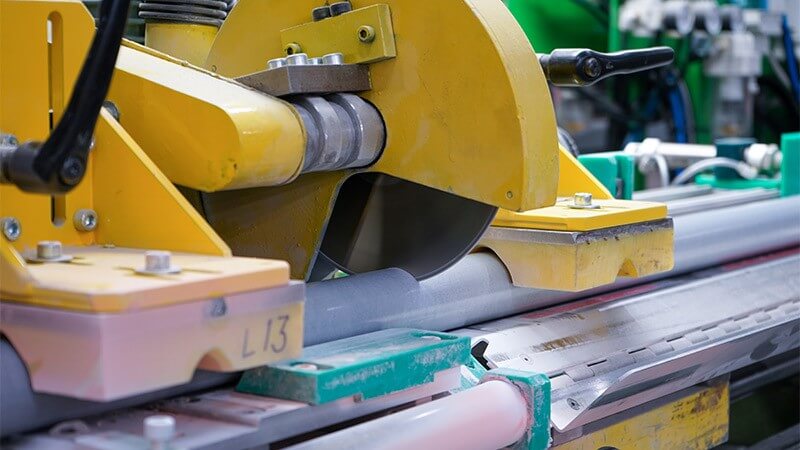
Continuous manufacturing produces the base profile or tube, but some composite products may require additional processing before they are ready for assembly or end use. Secondary processing adds application-specific details that help prepare composite components for integration into larger systems and finished products.
Typical secondary processing operations may include:
- Cutting and trimming
- Machining and drilling
- Surface finishing and coatings
- Printing and labelling
- Assembly and integration
- Kitting of systems
These processes help ensure that composite components meet application requirements, installation needs, and final product specifications. Depending on the application, secondary processing can also support aesthetics, environmental protection, product identification, and long-term durability. Learn more by visiting our dedicated secondary processing page.
From concept to composite
Manufacturing technologies are only valuable when they help solve real-world challenges. By combining continuous manufacturing, material expertise, and reinforcement engineering, composite products can be developed to meet specific performance requirements across a wide range of applications.
The choice of manufacturing process influences how a product performs, how efficiently it can be produced, and how consistently it can be manufactured at scale. Whether the objective is weight reduction, cost, durability, corrosion resistance, electrical insulation, or tailored mechanical performance, manufacturing plays an important role in translating design requirements into finished composite solutions.
Continuous manufacturing technologies such as pultrusion and pull-winding enable engineers to optimise products for both performance and production efficiency. Once a product has been validated, the same manufacturing principles can be applied repeatedly to help ensure consistent quality and reliable performance across production volumes.
At Exel Composites, manufacturing is integrated with material knowledge, engineering expertise, and production capability to help transform product concepts into practical composite solutions.
Where composite solutions are used
Continuous composite manufacturing supports applications across transportation, buildings & infrastructure, industrial equipment, power transmission, renewable energy, tubes & defense, and many other sectors where lightweight, durable, and high-performance materials are required.

Power transmission
Advanced composite conductor solutions for efficient, high-performance power transmission.

Transportation
Durable, lightweight composite solutions for demanding transportation applications and components.


Frequently asked questions
Q1: What is composite manufacturing?
Composite manufacturing is the process of combining fibre reinforcement materials and resin systems to produce lightweight, durable, and application-specific composite products. Different manufacturing methods can be used depending on the performance, geometry, and production requirements of the final application.
Q2: How do I know if continuous manufacturing is the right fit for my product?
Continuous manufacturing is typically a good fit for products with a constant cross-section, such as profiles, rods, beams, strips, or tubes, especially when repeatable quality and higher production volumes are required. Pultrusion continuously pulls dry fibres through a resin bath and heated die, producing a fully cured profile in a single operation that can run around the clock. This dramatically reduces labour requirements, eliminates the need for freezer storage and most batch-processing steps, improves material utilisation and increases production throughput. As a result, the cost per metre of product falls significantly as production volume increases above 1000m.
Q3: Why does the manufacturing process matter in composites?
The manufacturing process plays an important role in composites because it influences product geometry, mechanical performance, quality consistency, and production scalability. The manufacturing process helps determine how materials are combined and how the finished product performs in its intended application.
Q4: What is the difference between pultrusion and pull-winding?
Both pultrusion and pull-winding are continuous composite manufacturing processes. Pultrusion is commonly used for producing constant cross-section composite profiles primarily with axial fibers, while pull-winding extends manufacturing possibilities for tubular products by introducing additional reinforcement orientations that can enhance hoop strength and other performance characteristics.
Q5: How do I choose the right composite manufacturing process?
The most suitable manufacturing process depends on factors such as product geometry, performance requirements, production volume, and application goals. Understanding the relationship between product requirements and manufacturing capabilities helps identify the most appropriate production approach.
Q6: Can composite products be customised?
Yes. Composite products can be tailored through material selection, reinforcement design, manufacturing processes, and finishing operations. This flexibility allows engineers to optimise products for specific performance, durability, weight, cost and application requirements.
Q7: What is secondary processing?
Secondary processing refers to operations performed after the base profile or tube has been manufactured. Typical examples include machining, drilling, assembly, labelling, and surface finishing, helping prepare the component for installation or integration into the final product.