Pull-winding
What is pull-winding?
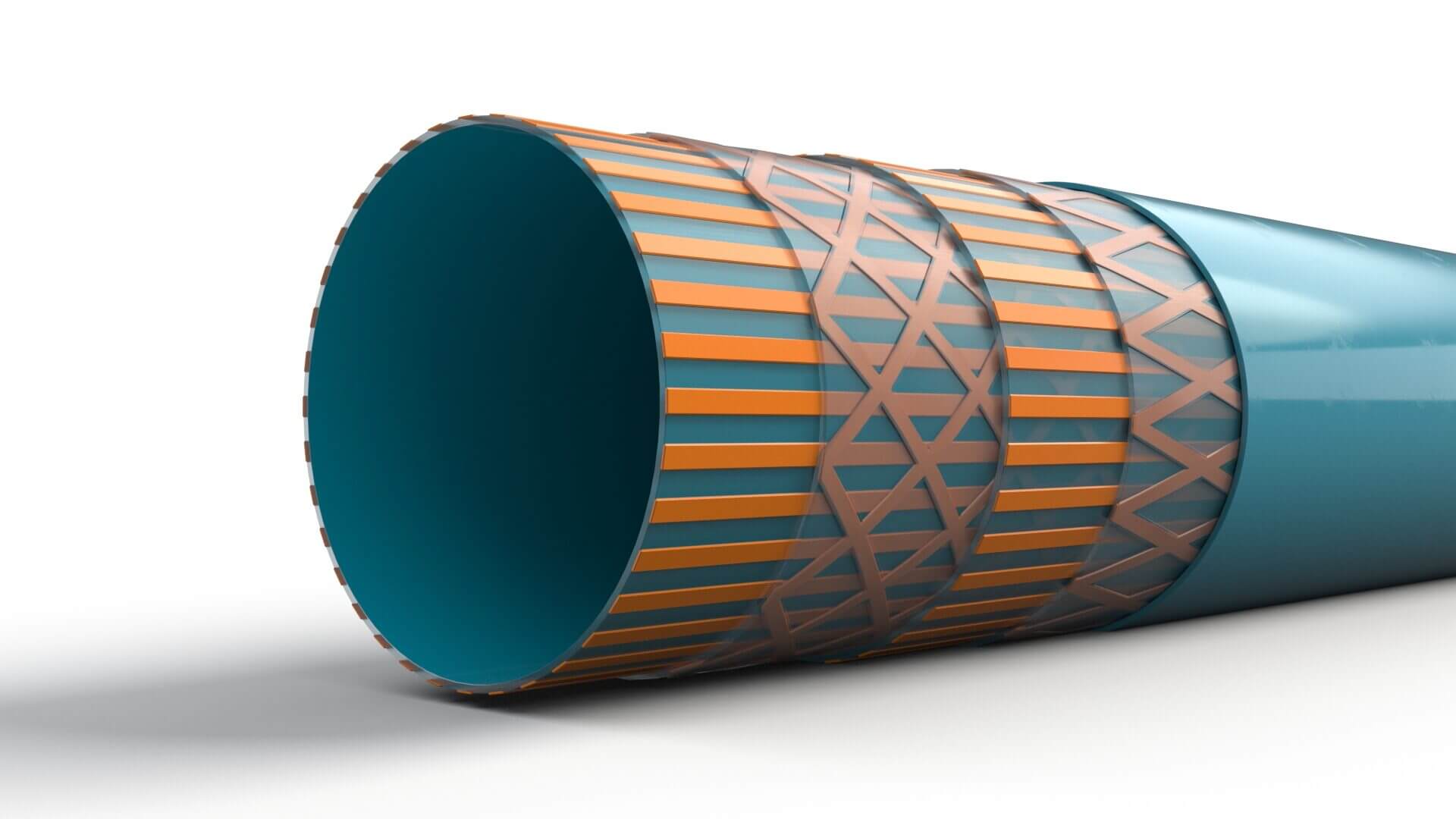
Pull-winding is a continuous composite manufacturing process that combines the efficiency of pultrusion with the reinforcement flexibility of filament winding. By combining axial fibers with fibers wound at controlled angles, pull-winding enables the production of lightweight composite tubes with tailored mechanical properties, optimised hoop strength and consistent manufacturing quality.
At Exel Composites, pull-winding is used to manufacture advanced tubular composite solutions and shapes with convex surfaces such as oval sections where conventional longitudinal reinforcement alone may not provide the required performance. By controlling fiber placement and winding angles, engineers can optimize products for requirements such as hoop strength, torsional performance, durability, impact resistance, and weight reduction.
The result is a manufacturing technology that combines engineered mechanical performance with the repeatability, scalability, and efficiency of continuous composite production. Pull-winding is particularly well suited to tubular applications where lightweight structures and application-specific performance are critical design requirements.
How the pull-winding process works
Pull-winding builds on the principles of pultrusion while introducing additional helical reinforcement orientations that enhance tubular performance. Continuous fibers are combined with fibers wound at controlled angles, impregnated with resin, and cured in a continuous manufacturing process to produce high-performance composite tubes.
The key difference lies in fiber placement. While pultrusion primarily aligns fibers in the longitudinal direction, pull-winding adds continuous wound fibers around the structure. This enables strength and stiffness to be distributed in multiple directions and helps improve hoop strength, torsional performance, and durability in thin-walled tubular constructions.
By combining axial and wound reinforcements within the same manufacturing process, engineers can tailor mechanical performance to specific application requirements while maintaining the consistency, repeatability, and efficiency of continuous composite production.
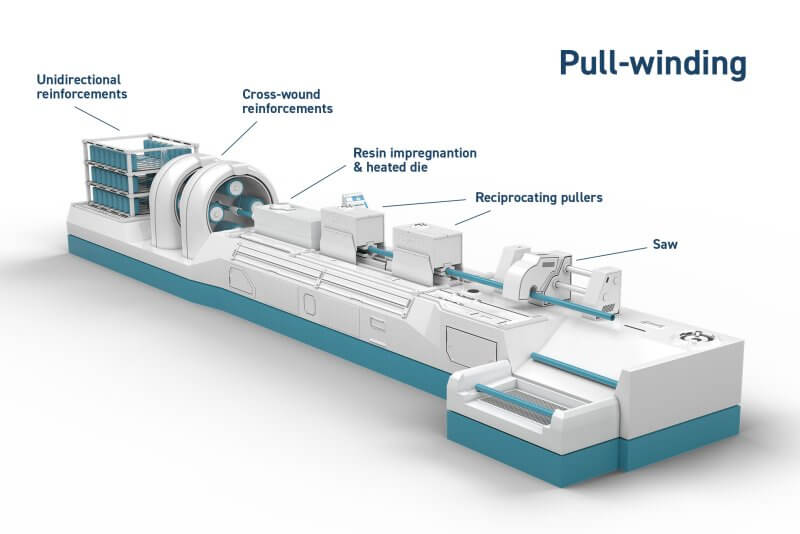
The pull-winding process step by step
| Step | Description |
| Unidirectional fibers | Continuous reinforcement fibers are introduced into the production line. |
| Crosswound reinforcements | Additional continuous fibers are wound around the structure at controlled angles. |
| Resin impregnation | Reinforcements are wetted with the selected resin system. |
| Continuous curing in heated die | The composite cures as it moves through heated tooling giving the tube or profile its final shape |
| Finished tube | Tubes are produced continuously and cut to the required length. |
Why engineers choose pull-winding
Many tubular applications require more than strength and stiffness in a single direction. Components may be exposed to radial forces, torsional loads, repeated impacts, or complex loading conditions that place demands on the structure from multiple directions. Pull-winding addresses these challenges by combining axial and wound reinforcements, enabling engineers to tailor performance to the specific requirements of the application.
Why fiber architecture matters
Unlike traditional tubular constructions that rely primarily on longitudinal reinforcement, pull-winding allows fibers to be placed in multiple directions. This enables engineers to tailor hoop strength, torsional performance, and structural behavior without unnecessarily increasing wall thickness or weight.
Key benefits of pull-winding

Enhanced hoop strength
Helical wound fibers improve circumferential reinforcement, helping tubes resist radial loads without significantly increasing weight.

Multi-axis ct performance
Axial and angled reinforcements allow strength and stiffness to be distributed in multiple directions.

Tailored mechanical properties
Fiber orientation and winding angles can be adjusted to optimize stiffness, torsional performance, durability, and impact resistance.

Lightweight design
Reinforcement is placed where it contributes most effectively to performance, helping reduce unnecessary mass and wall thickness.

Thin-walled tubular solutions
Pull-winding enables ultra thin wall tube constructions that maintain structural integrity, crush strength, and dimensional consistency.

Volume manufacturing
Continuous production supports consistent quality, and scalable manufacturing.
Materials used in pull-winding
One of the advantages of pull-winding is the ability to combine different reinforcement materials, resin systems, and fiber orientations to achieve application-specific performance. While materials play an important role in the final properties of a composite tube, pull-winding adds another level of control through reinforcement architecture, allowing engineers to tailor how the structure behaves under different loading conditions.
Reinforcement fibers
The structural performance of a pull-wound tube is influenced by both the reinforcement material and how it is positioned within the structure. Common reinforcement materials include:
- Glass fiber for a balance of mechanical performance, durability, and cost-efficiency
- Carbon fiber for high stiffness and lightweight performance
- Aramid fiber where impact resistance and toughness are important
- Hybrid reinforcement combinations that combine the benefits of multiple fiber types
- Different fibers can be combined within a single design to achieve specific requirements for stiffness, strength, durability, weight, and impact performance
For more detailed information on reinforcements, please take a look at our dedicated reinforcements page.


Resin systems
The resin system binds the reinforcement together and contributes characteristics such as environmental resistance, durability, thermal performance, and long-term reliability. Common resin systems used in pull-winding include:
- Polyester resins
- Vinyl ester resins
- Epoxy systems
- Bio-based resins
- Specialized performance resins
- The most suitable resin system depends on the performance requirements and operating environment of the final application.
The appropriate resin system depends on the performance requirements and operating environment of the final application. Our detailed page on resin choice explains further.
Fiber architecture and performance
Pull-winding allows reinforcement fibers to be placed in multiple directions within the same structure. By combining axial fibers with fibers wound at controlled angles, engineers can influence how a tube responds to different loading conditions.
This additional design flexibility makes it possible to optimize pull-wound products for requirements such as:
- Hoop strength
- Torsional performance
- Hybrid Glass/Carbon structures
- Lightweight structures
- Impact resistance
- Stiffness and durability
- Application-specific mechanical behavior
- The combination of material selection and reinforcement architecture is one of the key principles of designing with composites, and a key reason pull-winding can be used to tailor performance for demanding tubular applications.

Designing for pull-winding
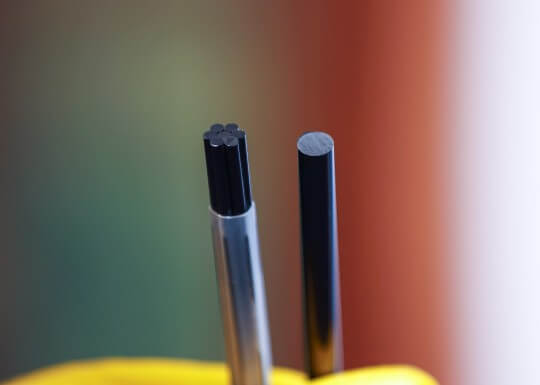
Pull-winding allows engineers to influence product performance through reinforcement architecture as well as material selection. By combining axial fibers with fibers wound at controlled angles, tubular structures can be designed to meet specific mechanical and functional requirements while maintaining the benefits of continuous manufacturing.
Key design considerations
Tube and profile geometry
Pull-winding is particularly well suited to tubular products and shapes with convex or flat surfaces (oval, rectangular or teardrop type shapes) with demanding structural or mechanical requirements. Tube diameter, wall thickness, and overall geometry all influence how reinforcement can be positioned within the structure and how the final product will perform.
Fiber type and orientation
One of the key advantages of pull-winding is the ability to place fibers in multiple directions. Winding angles and fiber type such as glass or carbon. can be adjusted to influence stiffness, bending behavior, torsional performance, and hoop strength, allowing tube performance to be tailored to the requirements of the application.
Application requirements
Design decisions should reflect the operating environment, loading conditions, durability requirements, and performance objectives of the final product. By aligning reinforcement architecture with application requirements, engineers can optimize strength, weight, and long-term performance.
Designing performance into the structure
Unlike conventional tubular manufacturing methods that rely primarily on material selection and wall thickness, pull-winding provides additional design flexibility through fiber placement and reinforcement architecture. This makes it possible to create lightweight composite tubes with performance characteristics tailored to specific applications and loading conditions.
Typical pull-wound products and applications
Pull-winding is particularly valuable for thin wall tubular applications where weight reduction, durability, and engineered mechanical performance are important requirements. By combining axial and wound reinforcements within a continuous manufacturing process, pull-wound tubes can be tailored to meet application-specific performance objectives while maintaining consistent quality and repeatability.
Typical pull-wound tube geometries
Pull-winding is specifically designed for tubular type products, circular, oval, teardrop, rectangular box shaped or similar. The technology enables engineers to optimize tube performance through fiber orientation and reinforcement architecture, making it suitable for both lightweight structures and highly engineered applications.
Industrial equipment
Pull-wound tubes are used in machinery, automation equipment, and industrial systems where lightweight structures, durability, and reliable mechanical performance are important. Tailored reinforcement strategies can help optimize stiffness, strength, and long-term reliability for demanding operating environments.
Robotics and automation
Robotic and automated systems often require lightweight structures with predictable mechanical behavior. Pull-winding enables tubes to be engineered for specific stiffness and performance requirements while helping to minimize unnecessary weight.
Medical technology
Medical and technical applications often benefit from lightweight composite tubes that combine dimensional consistency with application-specific mechanical properties. Pull-winding enables reinforcement strategies to be tailored to product requirements while maintaining manufacturing repeatability.
Drones and mobility solutions
Weight reduction is critical in many mobility applications. Pull-wound tubes can provide the required combination of strength, durability, and lightweight performance while enabling engineers to optimize structural behavior through fiber orientation and tube design.
Work and hand tools
Pull-winding is used in work and hand tools where performance, durability, ergonomics, and weight all play important roles. The ability to engineer reinforcement architecture makes it possible to achieve demanding performance targets while maintaining an attractive and lightweight design.
Why pull-wound tubes are used across industries
Organizations often choose pull-wound composite tubes when applications require:
- Lightweight structures with high performance
- Enhanced hoop strength
- Tailored torsional performance
- Excellent stiffness-to-weight ratios
- Excellent strength to weight ratios
- Durable and repeatable tube constructions
- Application-specific mechanical behavior
- Scalable manufacturing with consistent quality
These characteristics make pull-winding particularly suitable for applications where conventional tubular manufacturing methods or other materials such as metals may not provide the required balance of weight, strength, durability, and engineered performance.
FAQs
Q1: What is pull-winding?
Pull-winding is a continuous composite manufacturing process that combines unidirectional pultrusion and filament winding technologies to produce high-performance composite tubes with tailored off-axis angled reinforcement architectures.
Q2: How is pull-winding different from pultrusion?
Pultrusion primarily uses longitudinal unidirectional reinforcement along with fabrics, while pull-winding adds wound reinforcement orientations that enhance hoop strength and multi-directional performance. Why is pull-winding used for tubes?
The process enables reinforcement to be tailored around the circumference of the structure, helping improve hoop strength, torsional performance, and durability.
Q3: Can pull-winding reduce weight?
Yes. By optimizing fiber placement, designers can achieve performance targets without unnecessarily increasing wall thickness or component mass. The use of wound direct glass roving or carbon tow permits a higher volume fraction of fiber compared to fabric constructions resulting in lighter, stiffer profile.
Q4: Are pull-wound composite tubes a good alternative to tradition materials?
Pull-wound composite tubes can be an excellent alternative to traditional materials such as steel and aluminium, particularly where low weight, strength and durability are important. By combining longitudinal and wound fibres, their strength and stiffness can be tailored to the application, delivering performance where it is needed without unnecessary weight. While traditional materials remain appropriate for many uses, pull-wound composites offer a compelling opportunity to reduce weight and optimise component performance.
Q5: Which industries use pull-wound products?
Applications include robotics, medical technology, drones, industrial equipment, tool handles , and other industries requiring lightweight composite tubes with tailored performance.
Q6: Can pull-wound tubes be customized?
Yes. Fiber type, reinforcement architecture, winding angle, resin system, and surface finish can all be tailored to application requirements.
Need support with a pull-winding project?
Whether you are exploring lightweight tubular structures, advanced composite materials, or high-volume production requirements, Exel Composites can help evaluate the most suitable reinforcement strategy and manufacturing approach for your application.