Can two millimeters of carbon fiber change power distribution? – Case Tratos
The European power community has become familiar with the challenge of ageing transmission and distribution networks — without replacement, up to 55 per cent of European distribution lines will be over 40 years old by 2030, according to Eurelectric. When Italian transmission system operator (TSO) Terna asked conductor manufacturer Tratos to develop a smaller conductor product in December 2025, the OEM turned to Exel Composites to help assess its feasibility for upgrading Italy’s electrical transmission lines.
Advanced composite conductor cores have proven useful in high-voltage transmission applications in recent years, with studies showing 50 per cent increases in ampacity and 20-50 per cent reduction on transmission losses. However, they haven’t yet been so popular in smaller conductors, which could be used in both transmission and lower-voltage distribution networks. Terna is currently evaluating the feasibility of a product that might change that.
Upgrading networks with carbon fiber
Terna approached Tratos after spotting a gap in the market. Traditionally, Tratos has supplied underground cables and conductors for isolated power distribution, particularly for the medium-voltage side. Since 2008, though, it has leaned heavily into the high-voltage, overhead transmission conductor market.
In the past decade in particular, that work has focused on replacing the most common standard conductor in high-voltage transmission: 31.5 mm aluminum core steel reinforced (ACSR). This decision to reconductor the lines was driven by the cost and time required to build and modify the pylons, as well as thermal sag and its safety implications.
To equip electrical grids to meet the increased demand for electrification and decentralized power generation, TSOs must increase the overall transmission capacity of their network. Building new power lines is expensive and time-consuming, which is exacerbated by cautious regulations.
“In all countries, but particularly here in Italy, it takes years to acquire regulatory permission to alter or build new power lines,” explained Elisabetta Bragagni Capaccini, CEO of Tratos Group.
Line sag, whether old or new, represents a significant safety issue. As the steel core expands and contracts with the heat of the current and environment, the conductor gradually lengthens and sags down between towers. Minimum ground clearance for power conductors is tightly controlled by different national regulations — because of the danger that this sag poses to those on the ground.
Instead of new construction, Tratos has helped Terna to implement advanced conductors with composite cores in Italy by reconductoring existing transmission lines. Relative to steel, carbon fiber’s coefficient of thermal expansion is negligible: 0.2-0.9 against 11-12 10-6/K. As carbon fiber composite is also significantly stronger material than steel, it’s possible to maintain better tension between the towers, minimizing the sag.
Additionally the strength-to-weight ratio of carbon fiber allows for the creation of lightweight conductors with higher conductive cross-section compared to ACSR conductors, increasing transmission capacity by up to 50 per cent. For these reasons, conductors with carbon fiber cores have gathered momentum in power transmission applications.
Why hasn’t power distribution seen the same developments?
The financial argument around using carbon fiber in distribution is different to long-distance transmission. While the standard 15.85 mm conductors used in lines of up to 132 kV are still candidates for replacement, aluminum alloy conductors are considerably cheaper than those with carbon fiber. Distribution-level distances are also often shorter and don’t necessarily require the same high-level mechanical performance that composite material affords to transmission.
“It’s all about the right tool for the right job,” said Bragagni Capaccini. “For new lines, TSOs can choose the position of the pylons as they want, so aluminum alloy or aluminum-steel conductors make more sense.
“For existing lines though, traditional conductors often lack sufficient tensile strength or resistance to thermal expansion to support long spans. That heavier conductor forces a tower replacement, at which point the balance changes and carbon fiber becomes preferable,” continued Bragagni Capaccini.
“Purely from a CapEx point of view, carbon fiber is more expensive,” acknowledged Heini Kloster, product manager for conductor cores at Exel. “But in view of the towers, the extended service lifetime from composites’ unmatched durability, and the savings from preventing losses, it makes sense when revamping old lines.”
R&D partnership unlocks opportunities
The two companies first met at JEC World in Paris in 2017 and representatives like Francesco Ierullo, Exel’s vice president sales & marketing, engineered solutions and Albano Bragagni, president of Tratos, have visited each other’s facilities in Italy and England. Upon Terna’s enquiry, Tratos sought Exel’s support.
“We understood the mission was to make a smaller rod that we have pultruded before,” said Kloster. “This project was an interesting and important step for us in challenging the limits of size in our pultrusion process. Smaller rods seem to be raising interest in the market, and this is a need we wanted to provide a solution to.”
Pultrusion is a high-volume continuous manufacturing technique in which Exel Composites is a world leader, perfect for producing many kilometers of identical rods; ideal for overhead line conductors.
For Tratos, Exel product developers designed a 1.82 mm diameter profile and prepared new tools for the pultrusion process, as it does with all new profile sizes.
“We anticipated initial difficulties, as having fewer fibers in the rod can influence the stability of the production process, but the first sample run at our Joensuu factory went smoothly,” said Kloster.
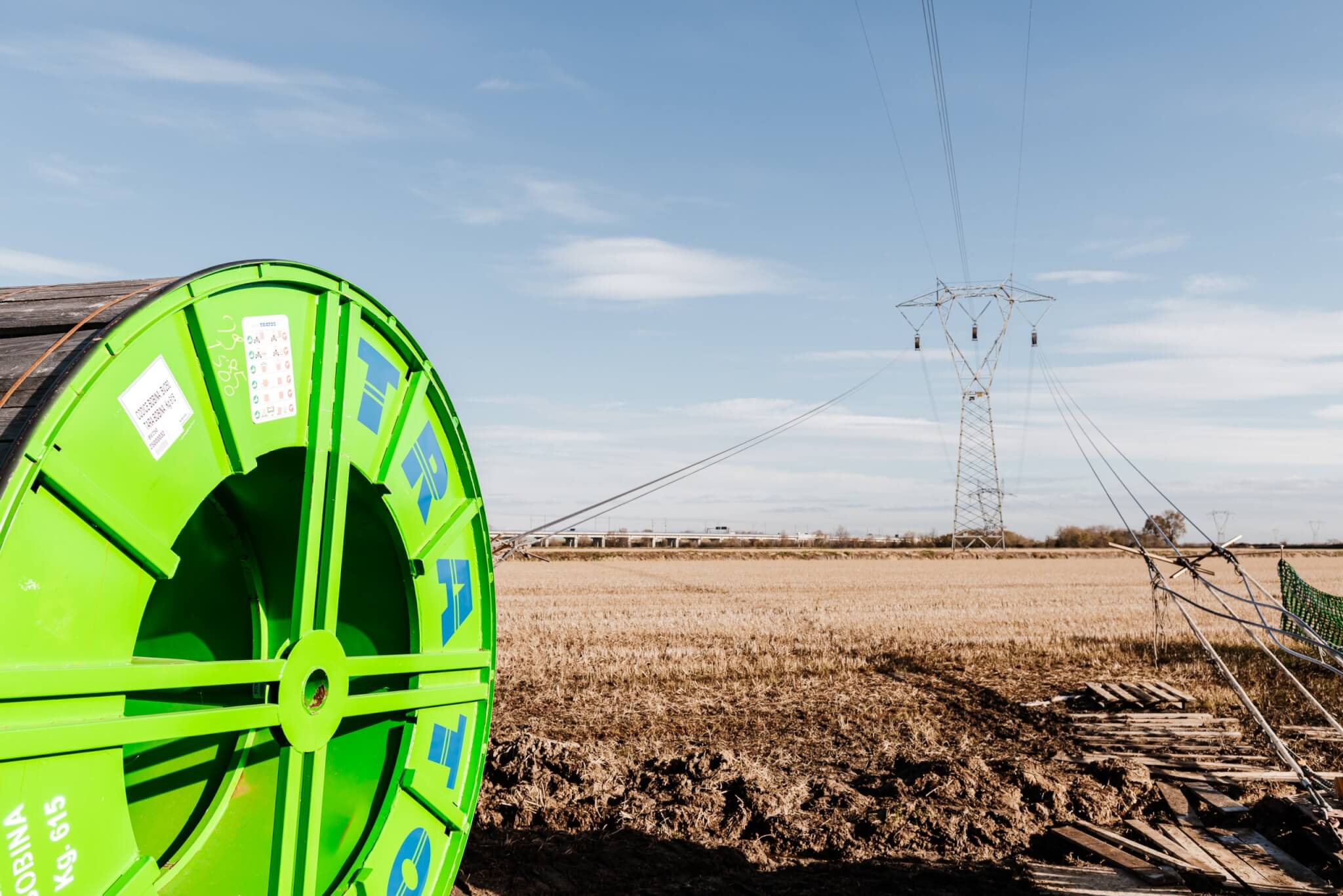
“We faced more challenges in the re-reeling process. The standard wooden reels were not totally uniform, leading to inconsistent winding in post-production. We solved that issue by switching the reel material to plastic — plastic reels are more uniform in shape and size, resulting in a more stable reeling process.”
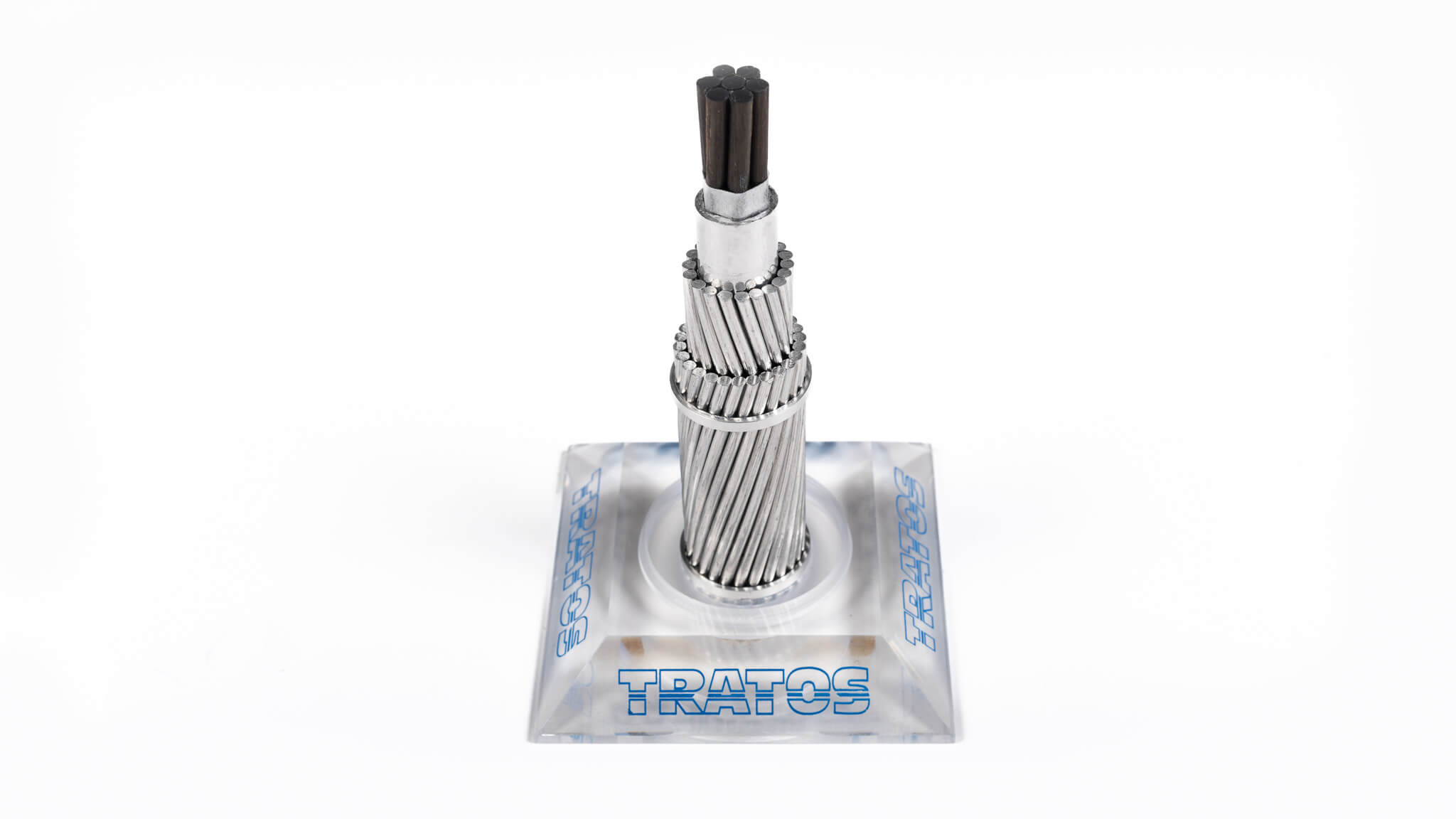
When Tratos receives the carbon fiber rods from Exel, it first strands the individual rods together, then extrudes a high-temperature aluminum tube over the stranded rods. Finally, it strands the aluminum wires on the core to form the conductor.
QC engineers test the product at each step, as any internal defects become invisible afterwards. Rigorous materials testing throughout development, based on Terna’s technical specifications, demonstrated the 1.82mm rod’s viability.
The 40 years test
Among the material and conductor tests employed by the partnership were: isothermal ageing; dynamic mechanical analysis (DMA); tensile strength; elastic modulus; thermos-gravimetric analysis; creep; ; coefficient of thermal elongation; and glass transition temperature. All are important, but the Arrhenius curve testing held particular interest due to its role in predicting long-term performance.
This accelerated thermal ageing technique simulates around 40 years of service lifetime in roughly a year by subjecting sample rods to high temperatures in ovens. While composite cores can enable even hotter conditions, testing so far shows that the 1.82 mm carbon fiber profile’s performance satisfies Terna’s requirement for
Terna suppliers must also satisfy company-specific regulations for construction, testing and installation. These are “Requirements for the construction, testing and supply of conductors with a polymer-matrix composite core”, and “Technical specification for verifying installation equipment for composite-core conductors”. As a long-time supplier, Tratos is well-practiced at meeting these standards; expertise that it shares with Exel Composites to mutual advantage.
Empowering the distribution community
At the time of writing, the conductor that uses the 1.82 mm carbon fiber core is under feasibility review by Terna. This could open opportunities for lower-voltage operators who have so far only had single-wire options available.
“The most persuasive argument to support any product is practical use cases, with irrefutable data that TSOs can compare against their own networks,” said Kloster. “By sharing what we know, what Tratos knows, and uniting the supply chain in conversation, we can accelerate the implementation a lot.”
“We’re talking to a couple of other TSOs about deploying carbon fiber conductor cores in their networks, and ultimately, collaborations like this are the motor that drive the progress.” said Bragagni Capaccini.
“We have a very good relationship with Exel. They come to meet us often, which we appreciate a lot. We’re a family business, so all important projects are handled by us directly. When we find a supplier that can also be a friend, with the right mindset, they are important to us,” she concluded.
To understand how composite conductor cores will affect the power that supplies your home and business, discover our free whitepaper here.