A piece of our history: The salesman who drove to the Olympics
Olli Pöllänen joined Exel Composites on September 1, 1974. He stayed for 15 years, saw the company dominate with 50 per cent market share in carbon fiber ski poles, and shared jokes with Olympic gold medalists. Sitting down with communications manager Marthe Dehli, he shares stories, many thought to be lost to time, about how a six million Finnish mark business became the €100 million Exel Composites of today.
He starts with the name: Explosive Electrics, referring to the electric detonator caps first produced by founder Yrjö Aho, gave us Ex- and El-.
“A great name,” Olli says with a smile. “It was easily understood and repeated internationally, I always thought it was a great name.”
By the time Olli arrived, 14 years after the company was set up, Exel had become a leading manufacturer of hearing protectors. The Silenta product line had begun a decade earlier, inspired by Matti Patteri, a colleague who represented Finland in pistol shooting at the 1968 Olympic games in Mexico.
Before Exel, Olli was working around central Europe, putting his language skills to work in Switzerland, Germany, Austria, and Sweden. This, paired with a common Nordic interest in skiing, allowed a Finnish colleague to pique his interest when he heard about Yrjö Aho and Exel’s next venture: glass fiber ski poles.
That’s snow business
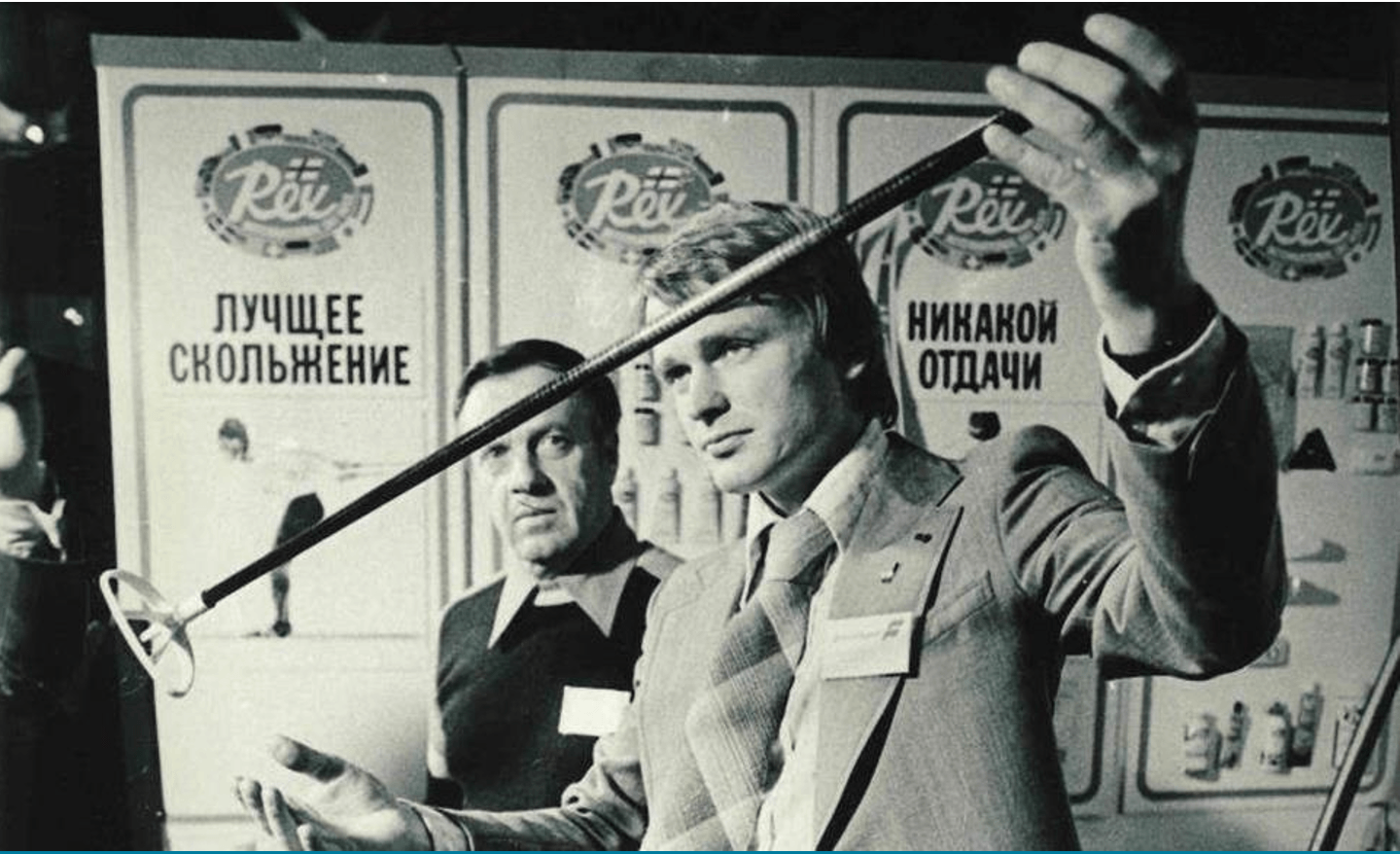
Olli jumped into his Peugeot 504 and drove to Helsinki to meet with Yrjö. He had offers from bigger companies, but two things about Exel Composites stood out. The first was an innovative patent for a butterfly basket, as opposed to the circular basket that was conventional for ski poles at that time. The second, and more important to Olli, was the people and culture that he found there in Helsinki.
“”I really liked the managers. Especially the president. That was the main reason — of course the product as well, because I had a history in skiing myself. But it was the people that really drew me into Exel,” he recalls.
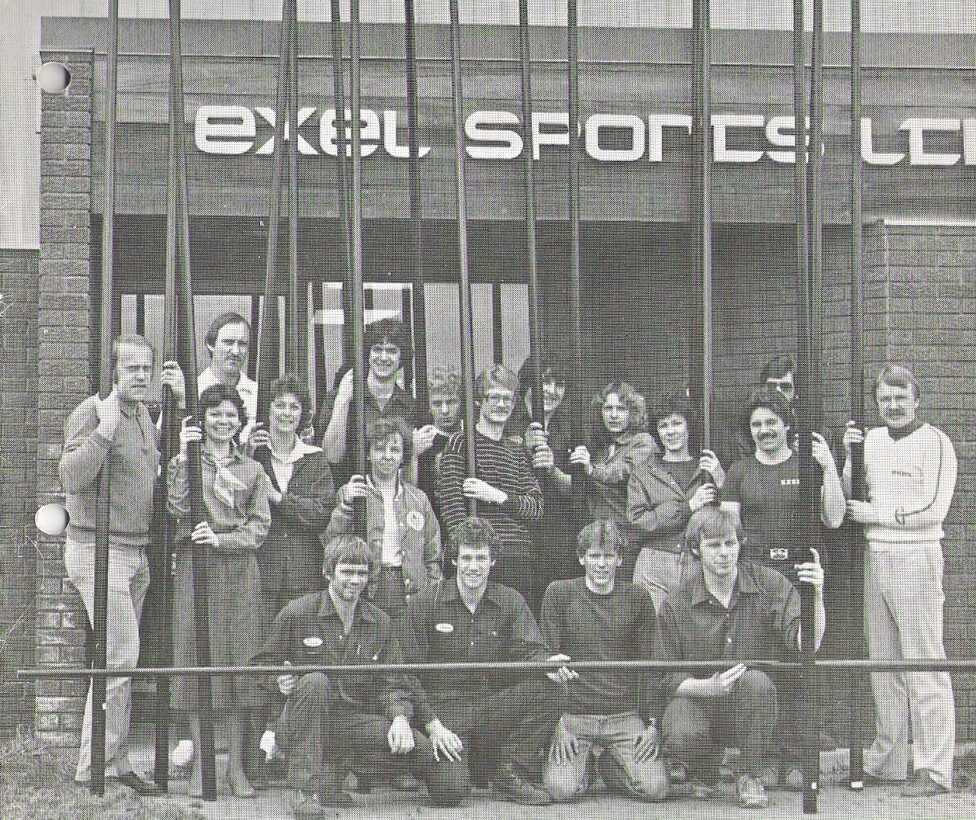
In 1973, Exel had bought an old glass factory in Mäntyharju and soon after Olli’s arrival, in December 1974, elite athletes at the Vuokatti Sports Institute were testing them. The quality was so high that they were accepted immediately and Olli, teaching ski instructors there in his spare time, saw with his own eyes the effect that Exel’s innovations had.
“Yrjö had noticed that the round baskets would often slip against the snow at an angle when skiers were planting their poles to push uphill,” explains Olli. “He redesigned it into a butterfly shape with no front edge, and it gripped the slopes like no other.”
From when Olli joined the team, the stage to debut these poles had been in place: the 1976 Winter Olympics in Innsbruck, Austria.
“Good ski poles, Exel”
When the time came, Olli loaded up his Peugeot to the roof with ski poles and set off for Seefeld, the Nordic venue for the Innsbruck Winter Olympics, with more following in a truck just behind.
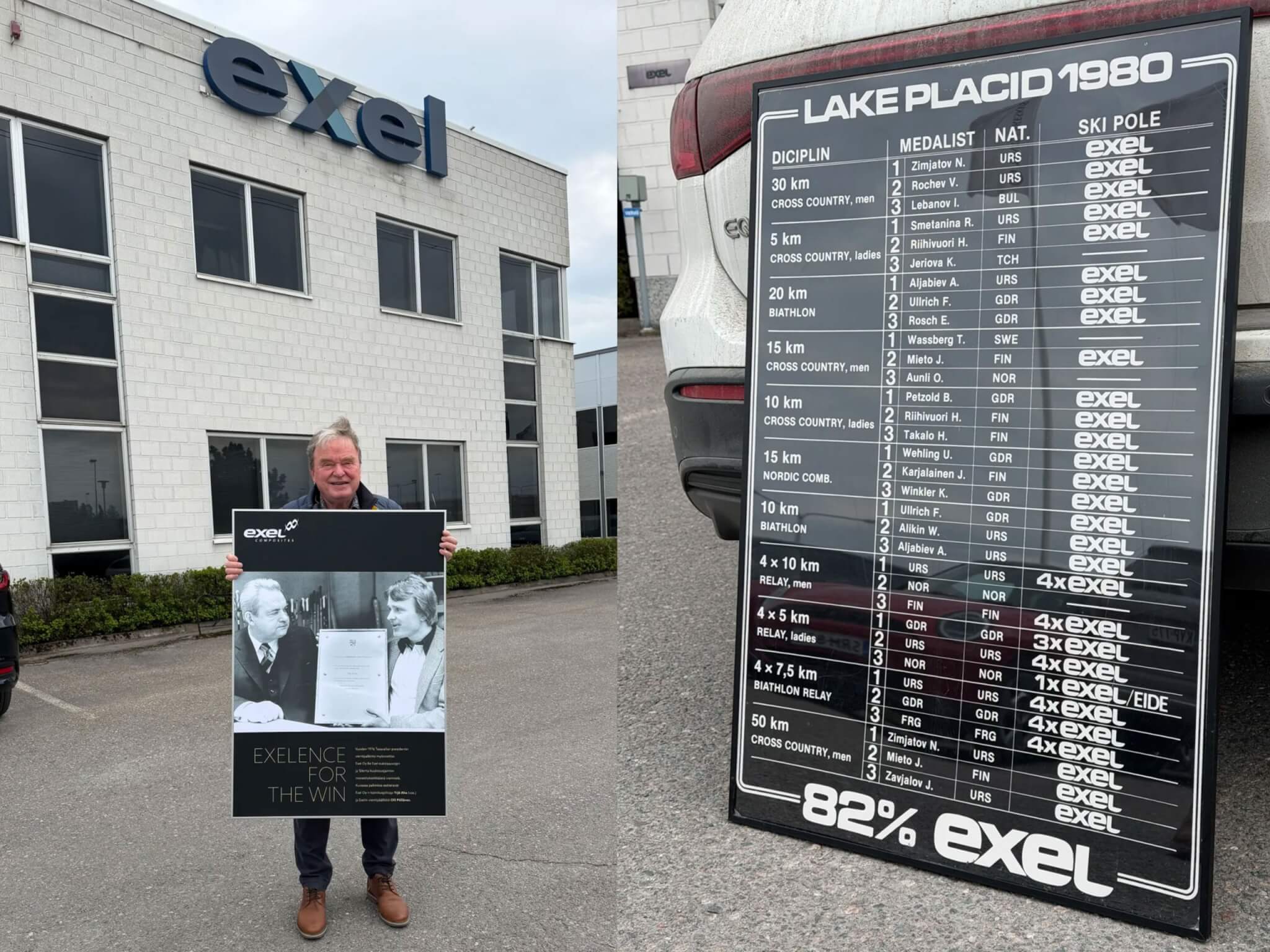
“Very few people knew about this ski pole before the 1976 Olympics,” he said. “And then 72 per cent of all medals were won using it. I didn’t have enough to go around! It was so much better than anything anybody had ever seen.”
The ski poles’ newfound popularity brought about one of Olli’s most vivid memories from his career with Exel. After Nikolay Bazhukov won the 15-kilometer cross-country skiing event, Olli went to the Soviet Union team’s hotel to congratulate him. He bumped into Bazhukov’s coach, who showed him to the athlete’s hotel room.
Olli knocked on the door. Bazhukov answered, fresh from the shower and wearing nothing. He saw Olli, smiled, and without a word, dropped to his hands and knees to fish something from under the bed. He turned around, holding his Exel ski poles and grinning, and said in Russian the only words Olli still remembers: “Хорошая лыжная палка, Exel”. Good ski poles, Exel.
That year, the President of Finland awarded Exel the President’s Export Award for the successful export of ski poles and Silenta hearing protectors. By the end of the 1970s, Exel was manufacturing 1.5 million ski poles per year. 400 people worked in the Mäntyharju factory, making this single product. Exel held a colossal 50 per cent of the world market, sweeping aside the Norwegian metal poles that had previously dominated.
Media marketing 101
In 1980, Yrjö and Olli decided that his sales expertise could best serve on a new frontier for Exel. He moved his family to Canada to support Exel’s business in North America and, after returning to Finland from 1986-1988, he flew back across the Atlantic in time for the 1988 Calgary Winter Olympics.
Twelve years on from their smashing success in Innsbruck, Exel introduced another innovation to generate interest: a new hand grip with a wrist support. However, this modification wasn’t popular with everyone. Olympics regulations required any product innovations to be made available to all teams at least one year in advance. When the Norwegian team learned about the Finns’ new kit, they challenged it immediately.
The Olympic technical committee met to hear both sides and provide a ruling. Olli and the Finnish coaches argued their case and secured a compromise. If the wrist support was removed, the poles could be used. Armed with some saws from the local hardware store, Olli spent the next few days cutting off the offending support — in full view of the television crews there to cover the sporting events.
“The legal dispute, can it be used or not, and the spectacle of cutting off the support from pole after pole; what could be better advertising than this?” Olli asks with a crafty smile.
The story ran on the sports news in Norway, Finland and Sweden, crucial markets for Exel’s sporting goods. Just like that, everybody knew about the new ski pole.
The legacy continues
Olli left Exel at the end of the 1980s as the marketing director, after his dear friend Yrjö had moved on from the company and satisfied that he had left a legacy of his own. He went on to become Finland’s Trade Commissioner and Consul in Canada, he ran multiple companies of his own, and sold Exel products as an agent until 2022.
When he talks about Yrjö Aho, Olli’s tone changes.
“I have sometimes said that he was almost like my father. We worked so much together and I really liked him,” Olli says.
Yrjö died in 2009. The pultrusion machines in Finland, Austria, the United States, and all Exel’s other manufacturing facilities around the world are faster, more precise, and digitalized compared to those first machines from the 1960s and 1970s, but the principle is the same one.
“If you look at the production lines now, they are much fancier. Much better in many ways. But it is still based on the same system he developed,” reflects Olli.
The company Yrjö, Olli, and the others built together is worth more than a hundred times what it was worth when Olli arrived. Many of our colleagues now have never heard the stories of what happened along the way. Olli Pöllänen’s is certainly one for the history books.