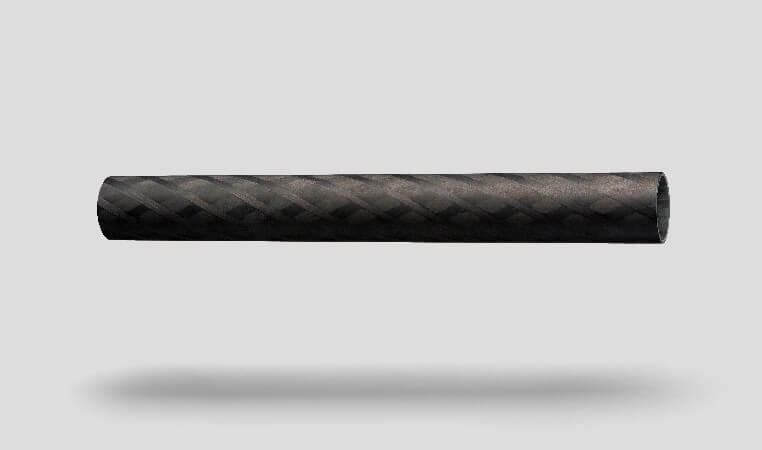
Continuous manufacturing produces composite profiles in an uninterrupted process, with components cut to length at the end of the line. This approach is well suited to high-volume production, delivering consistent quality across long runs while minimizing labor input. Techniques such as pultrusion and pull-winding have been used for decades across multiple industries, particularly where predictable mechanical performance and repeatability are essential.
Pultrusion provides a stable foundation for producing uniform cross-section profiles, while pull-winding extends design flexibility by introducing multi-directional reinforcement. When applied thoughtfully, these processes allow manufacturers to address both performance and cost targets without sacrificing scalability.
Designing for performance through pultrusion expertise
Pultrusion is a continuous process used to manufacture composite profiles with consistent geometry and material distribution. Continuous fibers are drawn through resin impregnation, compacted to remove excess resin and air, and cured with a heated die. As the material is pulled, rather than pushed, fiber alignment remains highly controlled throughout the process. Within pultrusion, fiber type, orientation, and resin selection can be adjusted to meet specific stiffness, strength, durability, and environmental resistance requirements.
The value of pultrusion lies in how precisely the process can be configured to meet defined performance targets. Pultruded composites provide predictable mechanical properties and long-term reliability across production volumes through controlled alignment of continuous fibers along the length of the profile.
Extending design freedom with pull-winding
While pultrusion excels at delivering uniform stability, many designs also require additional properties such as hoop strength, torsional stiffness, or impact resistance. Pull-winding serves as an extension of pultrusion where angled reinforcements are combined with axial fibers, mats, or fabrics and cured continuously in the same process.
The fibers are helically wound around a mandrel in a transverse direction, allowing for greater control of fiber placement, providing greater design flexibility and hoop strength in thin wall laminates. The resulting fiber geometry delivers multi-directional strength to thin-walled profiles. By adjusting winding angles and fiber combinations, engineers can fine-tune mechanical behavior without increasing wall thickness or weight.
Pull-winding is especially valuable in applications where ergonomics, weight reduction, or visual appearance are important, as it enables strength to be added selectively where it is needed most.
Expertise in combining techniques
Pultrusion and pull-winding are often discussed separately, but they were developed to coexist operationally to enhance product development. Integrating both techniques on a single production line allows manufacturers to tailor fiber alignment while maintaining the efficiency of continuous production.
Designers can select purely axial reinforcement, cross-wound structures, or hybrid layups depending on functional requirements. As both processes are highly automated, they can support large production volumes with stable output and minimal labor input. This makes them suitable not only for structural components, but also for consumer or industrial products where cost control and repeatability are vital.
From production capability to client partnership
Technical capability alone does not guarantee successful production: continuous manufacturing delivers its greatest value after defining product requirements early and implementing them into process parameters.
Close collaboration during design, testing, and validation helps to ensure that design requirements align with end-use performance. Manufacturers use early-stage trials and prototyping to verify assumptions and refine fiber alignment before full-scale production begins. This approach reduces the risk of customer miscommunication, late design changes, and improves confidence in full production runs.
Exel demonstrated this approach in the development of a lightweight, high-end tripod where competitor differentiation was a key customer requirement. It pull-wound one millimeter wall thickness tubes, combining carbon and glass fibers to optimize mechanics and achieve a smooth visual surface.
The cross-wound structure delivered hoop strength and durability. Traditional tubes are mainly unidirectional, with 90 per cent lengthwise fiber. Modern, optimized pull-wound tubes can be as much as 50 per cent crosswise fiber, allowing designs to meet the highest transverse or torsional requirements and consistent quality across production volumes.
Enabling the next generation of composite applications
Combined expertise in pultrusion and pull-winding can support a wide range of emerging applications. Medical devices, robotics, drones, and industrial tools all demand lightweight structures with specific mechanical properties and reliable scalability. When developed in collaboration between manufacturers and OEM customers, continuous manufacturing can meet these challenges. The united capability of both techniques allows designers to think beyond production constraints.
Axial stiffness, torsional performance, impact resistance, and wall thickness can all be engineered into the product through fiber placement. The automated nature of continuous manufacturing ensures consistent quality and cost-effective solutions, even with high production volumes. The modular design of pultrusion machines enables integration of pull-winding capability, allowing customers the opportunity to verify designs before going into production.
Ultimately, Exel does not offer continuous manufacturing as a standalone process, but as a comprehensive engineering solution. By integrating design, materials, and production expertise, Exel enables complex product designs to be transformed into high performing composite solutions.
Discover more about our continuous manufacturing processes by visiting here.